Share
Wednesday, March 25, 2026

On March 19, 2026, ESCR-Net hosted the webinar Digital Activism: Social Media Strategies for Justice. The session brought together communicators and activists from around the world to share strategies for engaging on social media in increasingly contested digital spaces — particularly in contexts where far-right and anti-rights narratives are gaining ground.

Share
Webinar 11
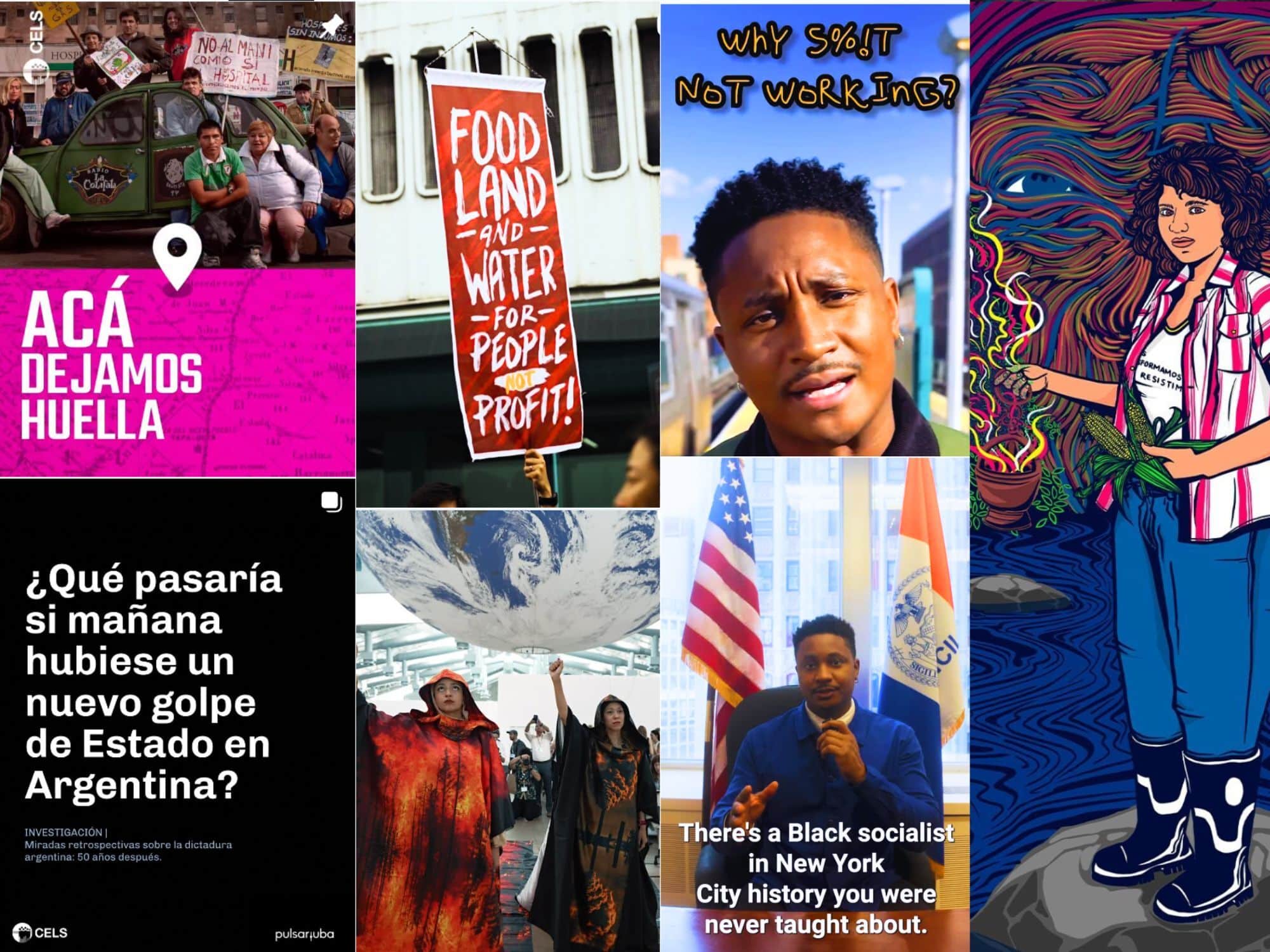
Strategies in action: examples of campaigns and content shared by the speakers in ESCR-Net's webinar: Digital Activism and Social Media Strategies for Social Justice

The conversation featured:

  • Vanina Escales, Director of Communications at CELS (Argentina)
  • Camilo Bermúdez, COPINH (Honduras)
  • Melike Futtu, Artivist Network (Turkey)
  • Elijah Fox, former Communications Director, Office of NYC Council Member Chi Ossé (United States)

Together, they shared concrete experiences of what works (and what doesn’t) when trying to reach new audiences, shift narratives, and build power through communication.


When politics happens quietly, money wins. So it’s our responsibility to make it loud.
— Elijah Fox

That line from Elijah Fox stayed with us after the conversation. It captures something many of us feel in our day-to-day work: communication is not just about visibility or making things look “nice.”

Communication is a deeply strategic practice. It requires understanding audiences, identifying what drives engagement, and making intentional choices about how narratives land. But it’s also something messier and more alive: it involves listening, experimenting, testing ideas, failing, adjusting, and trying again.

Here are 5 ideas (and quotes) we’re still thinking about — plus one bonus we couldn’t leave out:

1. Creativity doesn’t just happen: we need to create the space (and time) for it
Activists already have creativity. They just need facilitation spaces. As communicators, we should create those spaces.
— Melike Futtu (Artivist Network)

This means creating space for collective thinking, where movements can develop visual, written, and sensory narratives: from performance to music to cultural practices that are often left out of communication work.

And it also means accepting something we often resist: this takes time. As Melike shared, some of their processes (like preparing for COP) start months in advance, bringing people together to think, design, and align.

“Grounded digital activism must come from on-the-ground work — otherwise it becomes performative and top-down,” said Melike.

She also stressed thinking beyond the moment: planning documentation, working with media so that actions travel, and reusing and adapting materials over time so that campaigns grow rather than starting from scratch.

2. Your video is probably too long
A short video should be under three minutes to be distributed well by the algorithm, and under two minutes to perform best.
— Elijah Fox

Elijah shared very concrete lessons from working with short-form video. Because content is distributed beyond your existing audience, what matters most is whether it captures attention quickly and reaches the right people.

“One of the things that makes these platforms so powerful is that you’re able to reach different audiences at a very low cost,” said Elijah.

In their campaign to eliminate broker fees in New York City — a policy that had failed multiple times due to strong real estate lobbying — they used short videos to reach millions of people, far beyond their base. This helped turn a technical housing issue into a broader public conversation — something people were talking about in everyday life, even becoming “cool” to discuss.

That means being concise, getting to the point early, and understanding that the first few seconds shape whether the video will travel.

3. If everything is a reaction, you’re losing the story
We are constantly reacting… and we stop telling what protest does.
— Vanina Escales (CELS)

Vanina pointed to a real tension: much communication is driven by urgency, reacting to repression, policy changes, and attacks. But over time, that leaves little space to show what our work actually produces. We stop telling what protest is, what we learn in protest, what it gives us in terms of community, ” she added. 

Vanina also told us that narratives are not something you invent on the spot:  they need to connect with people’s lived realities and values, and help them feel they are part of something larger.

The shift is not to stop denouncing,  but to make space for something else alongside it: stories that connect, bring people in, and show what is possible.

4. We cannot speak to everyone in the same way
We cannot speak to all audiences in the same way.
— Camilo Bermúdez (COPINH)

Camilo emphasized that communication starts with understanding your audiences: who they are, what interests they have, and how to reach them. Different audiences require different messages, channels, and approaches.

“We have learned that we cannot use only social media… other forms of communication can be very effective,” said Camilo.

For COPINH, that means combining different strategies: organizing in-person gatherings to sustain collective memory, using public space through projections and visual actions, and producing short videos for platforms like TikTok that have reached hundreds of thousands of people.

5. It’s not enough to be right: it has to be engaging
Humor and empathy are key.
— Vanina Escales

One of the most challenging reminders: people don’t mobilize only because something is just; they mobilize when it feels meaningful, collective, and alive.

“Make participation not only morally right, but exciting and fun,  said Elijah. He spoke about making participation culturally relevant and something people want to be part of,  not just something they agree with.

Vanina pointed to the risk of fatigue in a constant flow of bad news, and the need to work with empathy, and sometimes humor to keep people connected.

If it doesn’t engage, it doesn’t land.

+1 Bonus: We need each other
Communication work can feel very lonely… but we need to remember that we have each other.
— Melike Futtu

Behind all strategies, tools, and formats, this also came through: communication is collective work. Sharing, testing, and supporting each other is not extra: it’s part of the strategy.