Share
Thursday, June 20, 2024
Share

Nature of the Case

Before a developer is allowed to proceed with a project which is likely to have significant environmental impacts, the developer is required to conduct an environmental impact assessment (“EIA”) for the public and the relevant planning authority to review and consider as part of the approval process. This case considers whether greenhouse gas emissions resulting from oil extraction (“Scope 3” or “downstream emissions”) should be considered as part of the environmental impact for the purposes of an EIA that is required before a planning authority considers whether to grant permission for the extraction of the oil. 

Summary

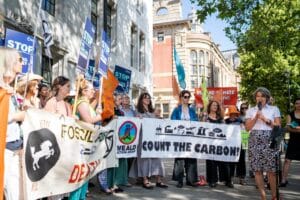
The developer, Horse Hill Developments Ltd, applied to Surrey County Council for planning permission to retain and extend the existing well site (comprising two wells) to drill four new wells, and to extract hydrocarbons from the six wells for commercial production. The proposed plan was for a 25-year project in which one phase encompasses the extraction of oil from the wells over 20 years. It is estimated that over this period the total quantity of oil produced could be of the order of 3.3 million tons. In September 2019, the Council granted the developer’s application. The claimant, Sarah Finch, a local resident and climate activist applied for judicial review of the Council’s decision and argued that the Council should have taken into consideration the effects of the downstream emissions from the eventual combustion of the oil extracted as part of the EIA and the Council’s failure to do so was a breach of the UK’s obligations under European Union Law , the “EIA Directive” specifically, as incorporated under UK domestic law. Finch, on behalf of Weald Action group, was initially unsuccessful before the High Court and Court of Appeal and appealed to the UK Supreme Court, asking it to decide whether it was lawful for the Council to restrict the scope of the EIA to exclude the subsequent emissions from the burning of the extracted oil. 

Respondents argued that whether the combustion emissions were effects of the project was a matter of evaluative judgment for the Council and an exercise of the Council’s discretionary authority, which would not be proper for the Court to review in this case.

The Court held that the Council’s decision was unlawful because the resulting emissions are within the scope of the EIA as required by law. The Court considered that the resulting emissions arising from the combustion of the oil extracted were inevitable: “The purpose of extracting fossil fuels is to make hydrocarbons available for combustion. It can therefore be said with virtual certainty that, once oil has been extracted from the ground, the carbon contained within it will sooner or later be released into the atmosphere as carbon dioxide and so will contribute to global warming.” The Court also found that the EIA Directive did not impose a geographical limit on the scope of environmental effects that could occur outside of the project site and should be assessed. The Court emphasized the need for the public to be aware of the environmental impacts of such a project or development through education in environmental matters as necessary to increase transparency and guarantee rights of public participation in the decision-making process. 

Enforcement of the Decision and Outcomes

Domestically, Finch has already had a marked impact. Following the Supreme Court’s judgment in Finch, the Secretary of State for Housing, Communities and Local Government accepted that the decision to approve a controversial coal mine in Whitehaven, Cumbria had been legally flawed and conceded the legal challenges to the approval. The Secretary accepted the error as serious and that it deprived the public of their rights of access to information on the climate impact of the proposed mine and their rights to participate properly in the decision-making process. Subsequently, the mining company failed in a bid to defend the decision (notwithstanding that the Secretary of State had abandoned it) – with the judgment in that case being given by Mr. Justice Holgate. The government made a similar concession in a case concerning an application for an oil drilling development in Biscathorpe, Lincolnshire. 

Then, in January 2025, the Scottish Court of Session ruled that consent for two new Scottish oil and gas fields (Rosebank and Jackdaw) had been granted unlawfully and that a more detailed assessment of the fields’ environmental impact was required, taking into account the effect on the climate of burning any fossil fuels extracted.

On 19 June 2025 (and in light of the Supreme Court’s decision in Finch) the government issued new environmental guidance on how the global environmental impacts of proposed offshore oil and gas projects in licensed fields should be assessed so as to ensure that the full effects of fossil fuel extraction on the environment are recognized in consenting decisions.

Significance of the Case

This landmark decision requires developers to take into account the downstream effects of not only the drilling of oil itself, but of the inevitable combustion of that oil which is extracted when publishing EIAs. Climate activist Sarah Finch stated, “This is a welcome step towards a safer, fairer future. The oil and gas companies may act like business-as-usual is still an option, but it will be very hard for planning authorities to permit new fossil fuel developments – in the Weald, the North Sea or anywhere else – when their true climate impact is clear for all to see.”

The Finch judgment can set a new global standard for environmental scrutiny, as it has been referenced by the Judges of the International Court of Justice, and reflected in the European Free Trade Association (“EFTA”) Court when it declared in May 2025 that European Union law—applicable pursuant to the European Economic Area (“EEA”) Agreement—prohibits the approval of fossil fuel projects without first assessing the global climate impacts of their emissions, including the Scope 3 GHG emissions.

As a result, investors and corporations not just in the UK, but in Europe and across the globe may well face stricter regulations, potentially shifting the landscape of global project planning and investment.


Other Resources:

Isabella Kaminski, “Future impact of proposed fossil fuel projects must be assessed, UK court rules.” The Guardian, June 20, 2024; available at https://www.theguardian.com/environment/article/2024/jun/20/landmark-supreme-court-ruling-throws-doubt-on-new-uk-fossil-fuel-projects 

Press Summary of R (on the application of Finch on behalf of the Weald Action Group) (Appellant) v Surrey County Council and others (Respondents), June 20, 2024; available at https://supremecourt.uk/uploads/uksc_2022_0064_press_summary_0af73e4878.pdf 

Sabin Center for Climate Change Law, “R (Finch on behalf of the Weald Action Group & Others) v. Surrey County Council (& Others)” Columbia Law School and Columbia Climate School Climate Change Litigation Databases; available at https://climatecasechart.com/non-us-case/r-finch-v-surrey-county-council/


For their contributions, special thanks to ESCR-Net member: the Program on Human Rights and the Global Economy (PHRGE) at Northeastern University.