Throughout COP30, ESCR-Net grounded its interventions in its Six Pillars to Decolonized Climate Action, calling for peoples-led solutions, feminist intersectional analysis, reparative finance, protection of defenders, confronting militarism and extractivism, and ending corporate capture.
One of COP´s headline outcomes was the adoption of BAM, the first of its kind to formally recognize the role of frontline communities in shaping transition pathways. While celebrated as a breakthrough, ESCR-Net stressed that its impact depends on whether states deliver dedicated climate finance –public, adequate, and non-debt-creating– and protect the mechanism from corporate capture.
“The mechanism exists because movements forced it into being, not because states offered justice,” said Haneen Shaheen of the MenaFem Movement. “We didn’t win finance; we won the space to fight for it,” she added, underscoring the lack of commitments to a reparative finance needed for a truly just transition.
COP30 also failed to address concerns raised by civil society and climate movements about unilateral trade measures (UTMs), which increasingly penalize Global South economies under the banner of just transition. While Parties agreed to annual dialogues on UTMs, ESCR-Net warned that this falls far short of the enforceable protections needed to prevent new forms of colonial control and economic coercion.
At the same time, the outcome on the Global Goal on Adaptation falls far short of what is urgently needed, with Parties agreeing to triple funding over the next decade instead of acting now despite rapidly escalating climate impacts. For the frontline communities already facing irreversible damage, 2035 is far too late.
Reflecting the same systemic failures, instead of delivering real, public, non-debt finance, COP30 introduced new market schemes like the Tropical Forests Forever Facility (TFFF). Far from supporting communities or protecting forests, TFFF expands commodification of Nature. ESCR-Net rejects TFFF and all attempts to replace real climate finance with profit-seeking mechanisms.
Belém Gender Action Plan: Progress Shadowed by Rollbacks
Parties adopted the Belém Gender Action Plan (GAP) for 2025–2034, including the historic recognition of environmental human rights defenders. But movements highlighted that the GAP contains significant weaknesses.
“It is disheartening to see backtracking of human rights language,” said Ranjana Giri of APWLD. She noted that the plan lacks an intersectional framework, excludes gender-diverse people, and includes no direct finance for gender-responsive climate action.
For Camilla Pollera of the Center for International Environmental Law, protecting defenders is essential: “Defenders are on the front lines of climate action, even when fear, repression, or exclusion keeps them out of negotiating rooms. This was painfully evident at COP30.”
Loss and Damage: Communities Pay While Polluters Escape
Only two pledges were made to the Loss and Damage Fund, €21 million in total, compared to the $400 billion Global South countries need in 2025 alone. “Climate change continues to destroy the livelihoods of millions of smallholder farmers,” said Vladimir Chilinya of FIAN Zambia. “The failure by those responsible to provide finance shows a lack of concern for human rights in developing countries.”
Adrián Martínez Blanco of La Ruta del Clima added: “COP30 was empty of decisions to repair loss and damage. Neither rights nor legal duties should be on the negotiating menu. The UNFCCC must align with the law.”
Shereen Talaat of the MenaFem Movement added that COP30 once again exposed “the gap between recognition and action,” where states acknowledge rights yet ignore their legal obligations or provide real finance—even as Global South communities face droughts, floods, displacement, and austerity.
The loss and damage fund gap unfolded against the backdrop of rising global militarism, which drains public resources and intensifies climate harm. COP30 again failed to ensure transparency and accountability for military emissions, allowing one of the world’s most polluting sectors to remain exempt from scrutiny.
From Belém to Gaza: Militarism, Ecocide, and Defenders Under Threats
Repression and shrinking space for human rights defenders were also on full display in Belém. Indigenous Peoples mobilizing for their rights were met with riot shields and barricades—mirroring the violence defenders face worldwide when protecting land, water, and territory. These scenes echoed broader dynamics of militarism that fuels illegal occupation, genocide and environmental destruction globally. In response, ESCR-Net also supported the Global Energy Embargo for Palestine Campaign, which denounced the genocide and ecocide perpetrated in Gaza, and urged the UNFCCC to bar actors complicit in such harm from climate negotiations, including calls to “kick Israel out” of COP30.
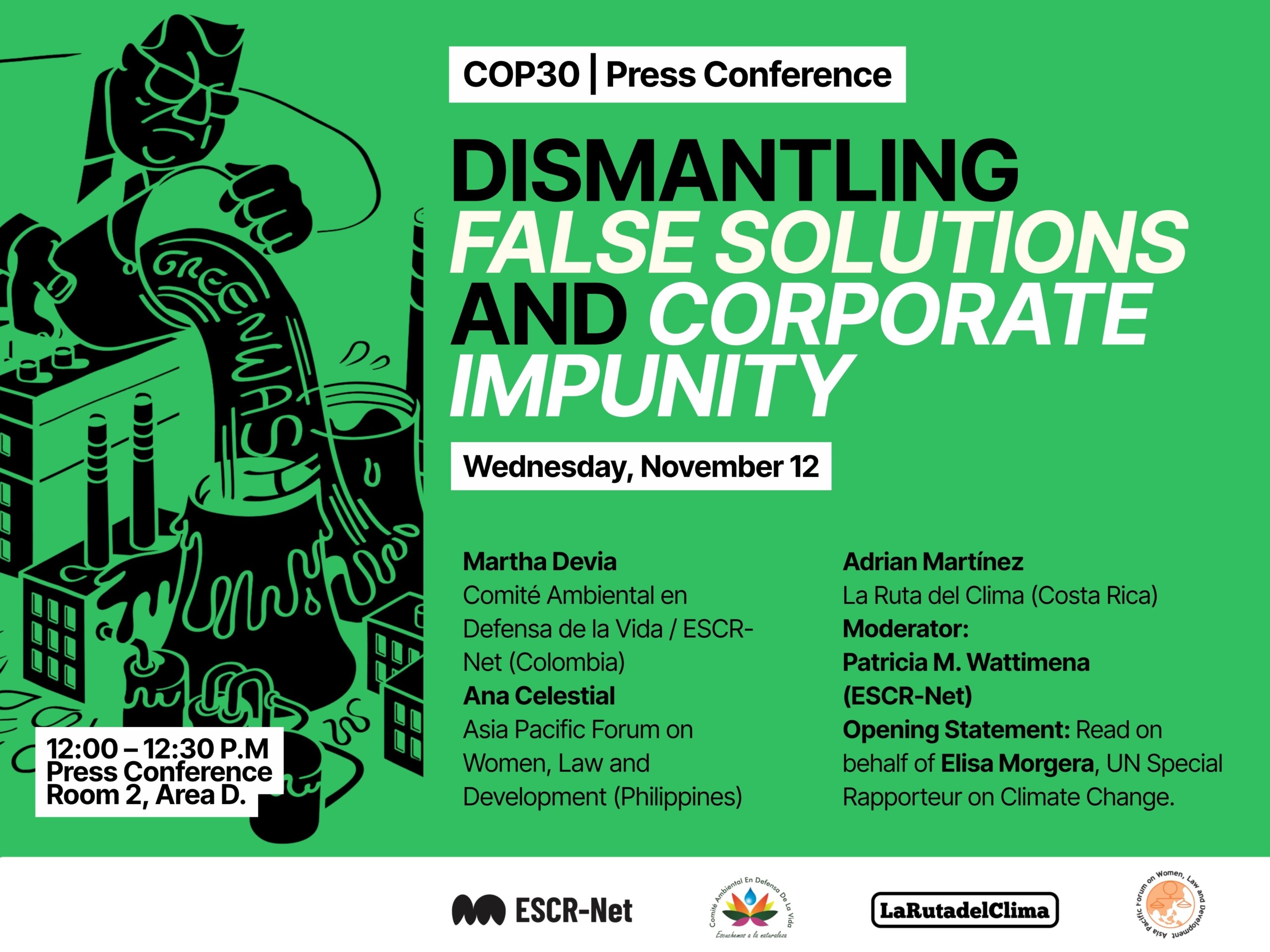
At an ESCR-Net press conference, Colombian defender Martha Devia Grisales warned that fossil fuel lobbyists were “writing the future of the planet” and called for a strong Conflict of Interest policy to curb corporate capture. Drawing on ESCR-Net’s Community-Led Research across Colombia, Mongolia, Mexico, Kenya, and Zimbabwe, she stressed that peoples-led solutions already exist. The message was clear: without binding international rules, such as those advanced through the Binding Treaty on Transnational Corporations and Human Rights, to curb corporate power and prevent states and corporations complicit in rights violations from shaping climate decisions, COP outcomes will continue to fall short of the justice communities demand.
A Rising Push for a Fossil-Fuel-Free Future
Despite the failure to secure a fossil fuel phaseout, momentum grew behind the proposal for a fossil-fuel-free future led by Colombia.
“The elephant in the room remains the fossil fuel phaseout,” said Sergio Chaparro Hernández of Dejusticia. He emphasized that achieving a fair transition requires reforms to the international financial system—including debt cancellation, international taxation, and technology transfer. “The promise of implementation will remain unfulfilled until the Global North pays its climate debt.”
While Colombia’s leadership helped push the phase-out debate forward, ESCR-Net members stressed that any pathway to a fossil-fuel-free future must be fair, adequately-funded, and free of global polluters and corporate-led manipulative schemes. Members underscored that transitions need to be rooted in feminist and intersectional analysis and guided by international human rights law—including recent rulings from the ICJ and the Inter-American Court—which affirm that historical emitters have binding obligations to prevent further harm, ensure accountability, and support peoples-led solutions.
“We are already on a path toward 2.6°C of warming. Tipping points are being crossed with increasing speed and force,” said Maddalena Neglia of the International Federation of Human Rights (FIDH). “The International Court of Justice affirmed what science and frontline communities have long asserted: ending dependence on fossil fuels is a human rights imperative to immediately abide by,” she added.
Real Solutions: From the Peoples, Not Polluters!
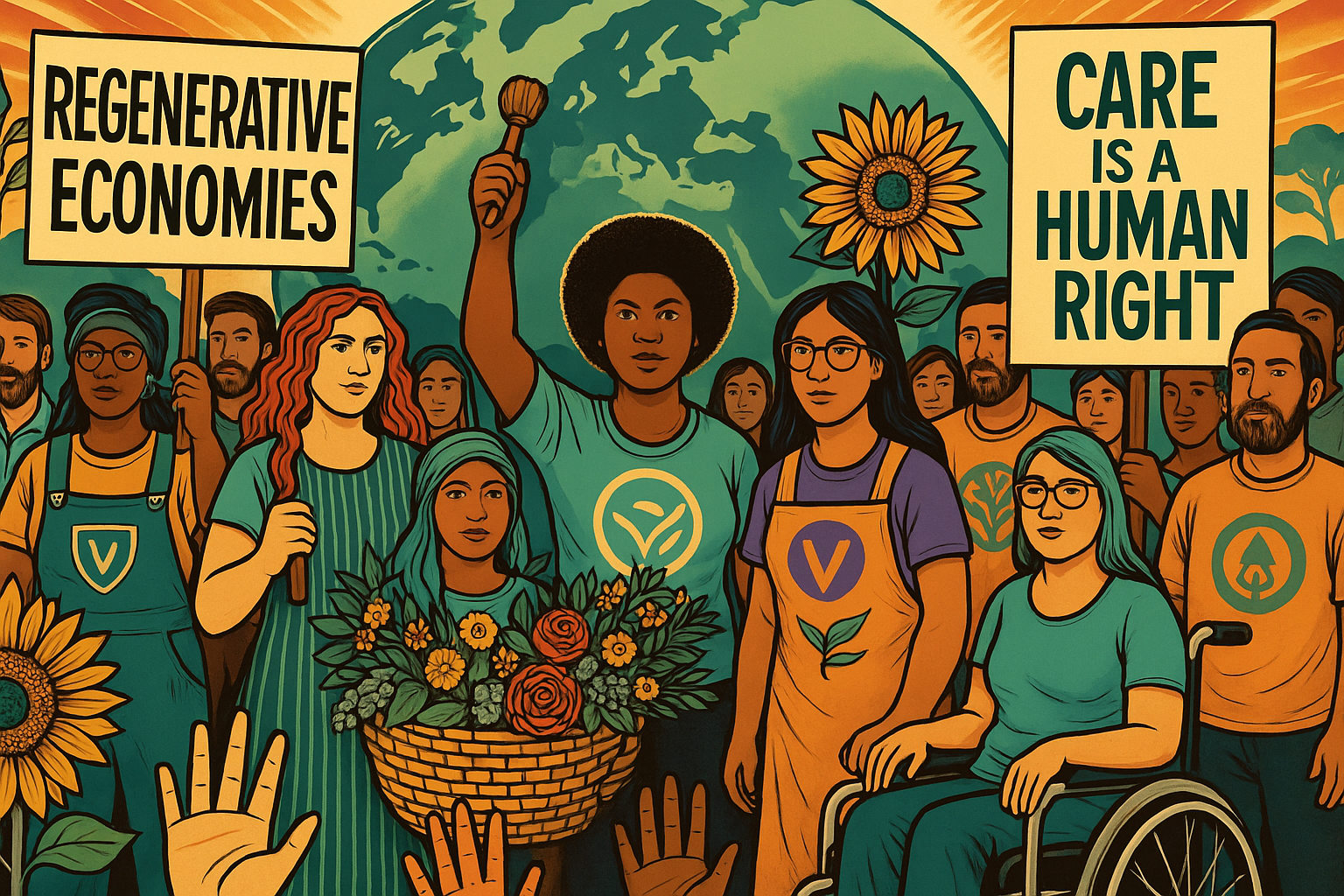
Across the world, Indigenous Peoples, feminists and grassroots women’s movements, peasants, workers, and other frontline communities are generating the real solutions needed to tackle the climate catastrophe—solutions largely invisible inside COP negotiations.
“Amid predictable resistance from global North countries, movements still secured a victory with the Just Transition mechanism,” said Jax Bongon of IBON International. “But now we must compel the North to deliver finance and commit to a rapid, equitable fossil fuel phaseout, while fighting false corporate ‘solutions.’”
ESCR-Net joined the 70,000 people who marched in Belém to demand justice and a fossil-fuel-free future, calling for real solutions from the peoples, and not from polluters. Members reaffirm that addressing the climate crisis requires a fundamental shift: ending fossil fuel subsidies, canceling illegitimate debt, halting massive flows of money feeding the machinery of war, and redirecting those resources toward loss and damage finance, reparations, and peoples-led climate solutions, including community-driven adaptation efforts.
Peoples-led solutions reclaim sovereignty and shift power away from corporations and back to the peoples. Across movements, ESCR-Net members continue to argue that any solution that fails to uphold human rights, self-determination, and dignity, particularly of the historically oppressed peoples, is not a real solution. It is climate colonialism and a direct attack on humanity and the planetary boundaries.