Share
Tuesday, April 28, 2026 ― Angélica Cuevas-Guarnizo | ESCR-Net

Indigenous leaders, environmental defenders, and climate litigation experts are examining how to turn international court opinions into tools for territorial defense and political advocacy. Insights from the United Nations Permanent Forum on Indigenous Issues.

Share
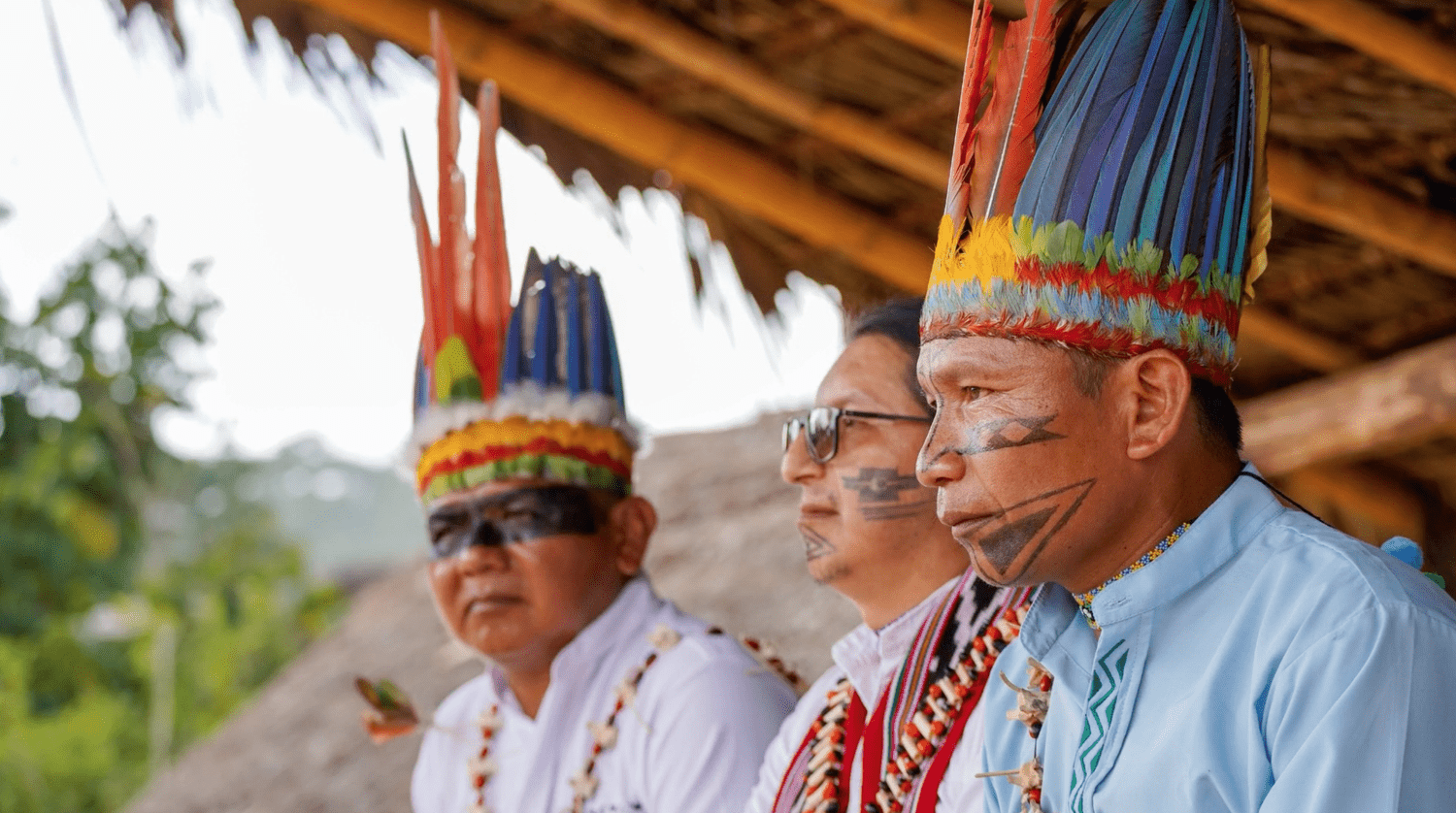
Leaders and authorities of the Kichwa People of Sarayaku (Ecuador) call for international recognition of Kawsak Sacha (“Living Forest”), which they declare a living being and subject of rights, central to their territorial defense and self-determination. Photo: The Cultural Conservancy.

NEW YORK — Advisory opinions on climate change issued in July 2025 by the International Court of Justice and the Inter-American Court of Human Rights, which clarify States’ obligations in the face of the climate crisis, have brought into sharp focus a critical challenge for Indigenous Peoples: how to transform these legal advances into concrete tools for defending their territories.

This discussion is unfolding this week at the 25th United Nations Permanent Forum on Indigenous Issues (UNPFII), with participation from ESCR-Net members, including Patricia Gualinga, Kichwa leader from Sarayaku and a Permanent Forum member, and Luisa Gómez Betancur, Senior Attorney at the Center for International Environmental Law.

These advisory opinions mark a turning point in international law. For Indigenous Peoples, whose lands and ways of life are on the frontlines of the climate crisis, they strengthen pathways to demand accountability from States and to challenge decisions that threaten their territories. According to the United Nations, Indigenous Peoples represent less than 6% of the global population but protect nearly 80% of the planet’s biodiversity, underscoring what is at stake.

Government representatives and leaders of the Kichwa People of Sarayaku, including Hernán Malaver (President of Sarayaku), leader Patricia Gualinga, and leader Daniel Santi (right), during the United Nations Permanent Forum on Indigenous Issues. Photo: Edilberto Gualinga.

The challenge is clear. These decisions must become operational on the ground. Their impact will depend on how they are integrated into concrete strategies in contexts shaped by extractivism and socio-environmental conflict.

Community-led research demonstrates that climate harm is not abstract. In Kenya, Endorois communities have documented the loss of more than 3,000 acres of land and the displacement of hundreds of families.

Luisa Castañeda-Quintana, Executive Director of Land is Life, stated during one of the Forum’s opening sessions:  “These advisory opinions are not symbolic; they are instruments of power. They must be taken up and brought into the spaces where decisions about Indigenous Peoples’ futures are made.” In other words, the value of these decisions lies not only in their existence but in their strategic use.

For Patricia Gualinga, Kichwa leader from Sarayaku, Ecuador, recent decisions by the Inter-American Court do not introduce new principles. They reinforce long-standing demands by Indigenous Peoples: recognition of their disproportionate exposure to the climate crisis, the legitimacy of their knowledge systems, and the obligation to respect free, prior, and informed consent. “The Inter-American Court goes much further. It recognizes that Indigenous Peoples are among the most affected and that our knowledge is a legitimate part of the climate response. No decisions can be made about our territories without our consent,” Gualinga said.

From this perspective, responses to the climate crisis must be grounded in territories and in Indigenous ways of life, governance, and relationships with nature.

“Our worldview, embodied in Kawsak Sacha (Living Forest), is our real contribution to addressing the climate crisis. We do not want imposed projects. We demand recognition of our vision, our systems of coexistence with nature, our life plans, our self-determination, and our own governance.” Gualinga emphasized that these decisions reinforce what communities have asserted for decades.  “The climate crisis is not only an environmental issue. It is a crisis of rights, survival, and territory.”

However, she warned of a persistent structural gap between legal recognition and implementation. What is written in legal texts continues to diverge from realities on the ground. “States are not listening, and our forest remains under threat,” she said.

Luisa Castañeda-Quintana (Land is Life), Luisa Gómez (CIEL), and Patricia Gualinga (Kichwa People of Sarayaku), during a side event at the UNPFII focused on advisory opinions on climate change and their practical applications for Indigenous Peoples. Photo: ESCR-Net

Three pathways from legal recognition to action

From the perspective of strategic litigation, Luisa Gómez Betancur, Senior Attorney at the Center for International Environmental Law, proposes translating advisory opinions into thematic and operational lines of action that Indigenous nations can integrate into their rights-claiming strategies.

The challenge is not only to analyze these opinions, but also to implement them. In this sense, Gómez identifies three key entry points offered by advisory opinions:

Positioning Indigenous knowledge as the best available science

Indigenous knowledge must be recognized as legal evidence on par with Western scientific knowledge. “Our task is to ensure that local and Indigenous traditional knowledge is recognized as the best available science in climate litigation and governance,” Gómez stated.

This requires, for example, its effective integration into tools such as environmental impact assessments, enabling more rigorous scrutiny of extractive projects and state decisions.

Advancing the protection of the rights of nature across jurisdictions

Gómez highlights that the advisory opinion of the Inter-American Court applies to more than 30 member states of the Organization of American States, including the United States, significantly expanding its legal reach.

In this context, the rights of nature, as recognized by the Court, are no longer confined to specific constitutional frameworks. Instead, they become enforceable arguments across the Inter-American system, opening new pathways for advocacy in jurisdictions where such standards did not previously exist.

Advancing the right to self-determination

The advisory opinion of the International Court of Justice warns that rising sea levels are driving forced displacement and undermining the territorial integrity of states, as well as their sovereignty over natural resources, with direct implications for the exercise of the right to self-determination.

This assessment creates a strategic entry point for climate litigation. This is not a new right; it is enshrined in multiple treaties ratified by states. The challenge lies in making it operational within courts and legal processes in the context of the climate crisis, strengthening the defense of territory and the political autonomy of Indigenous Peoples.

Gómez closed with a key warning: “Litigation alone is not enough. It is one part of a broader set of strategies and tactics for climate justice. It must be accompanied by strong campaigns, advocacy, and narratives that mobilize.”

A conversation that requires broader engagement

These dialogues are not isolated. They are part of broader efforts by civil society organizations and social movements to transform international legal standards into concrete tools for territorial defense.

Organizations such as the Center for International Environmental Law and Land is Life are working to ensure that more Indigenous Peoples can access and use these advisory opinions in their documentation, advocacy, and rights claiming strategies.

The challenge is not only legal. It is political. It requires ensuring that these tools are used to demand accountability and to halt decisions that continue to endanger Indigenous territories.

In this context, networks such as ESCR-Net play a critical role in strengthening connections between communities, legal strategies, and collective action.