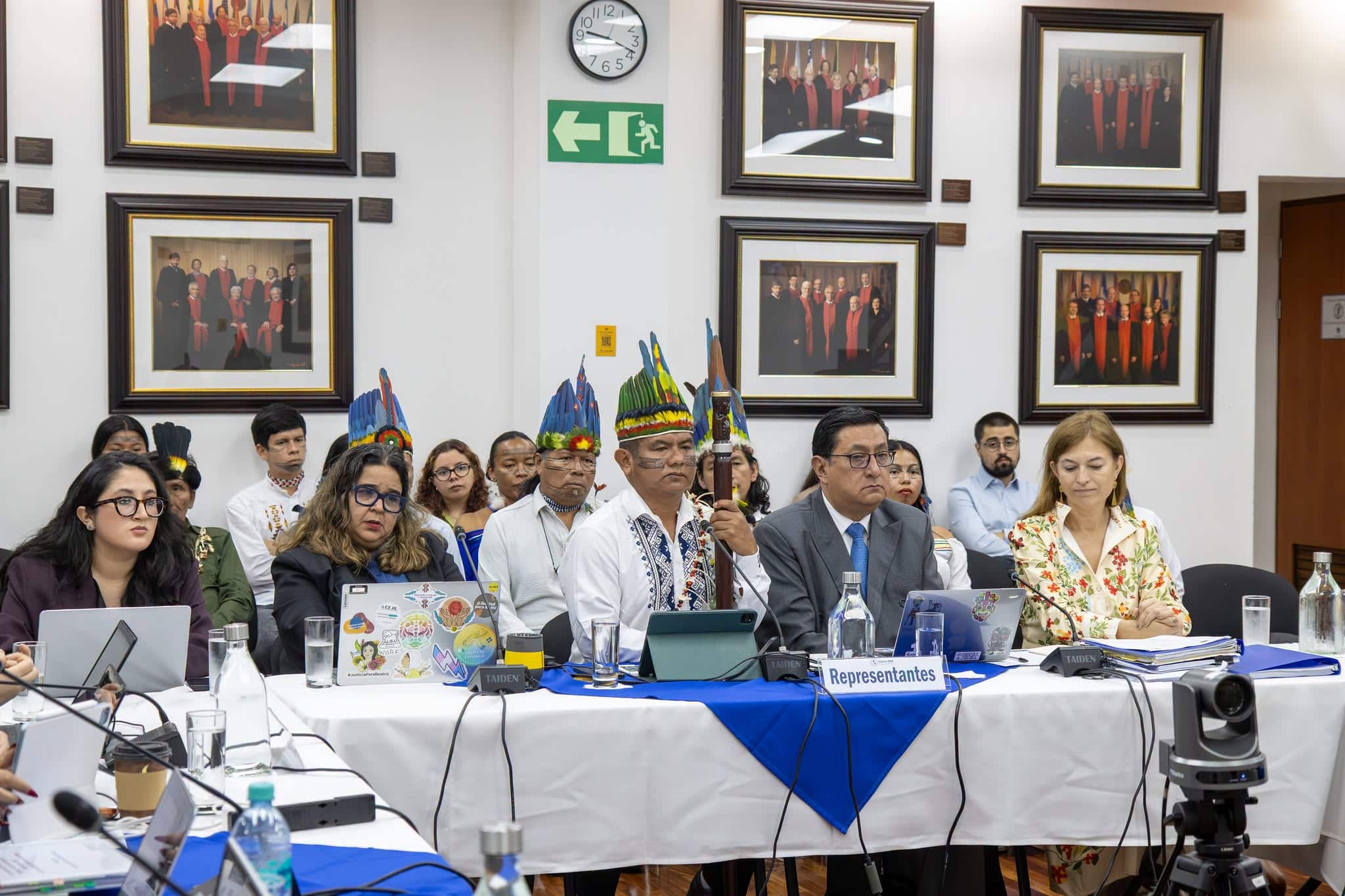
Following a private compliance monitoring hearing before the Inter-American Court of Human Rights, the Kichwa People of Sarayaku reiterated that the Ecuadorian State continues to fail to comply with key measures ordered by the Court more than a decade ago and put forward a historic proposal: the recognition of Kawsak Sacha (Living Forest) as a rights-bearing entity.
Fourteen years after the Inter-American Court’s judgment in the case Kichwa Indigenous People of Sarayaku v. Ecuador, significant failures remain regarding prior consultation, free, prior and informed consent, and the removal of explosives abandoned within the ancestral territory.
During the hearing, representatives of the Sarayaku People and their legal team demonstrated that the Ecuadorian State continues to fail to comply with three fundamental measures ordered by the Court:
- The adoption of adequate legislation on consultation and free, prior and informed consent in accordance with international human rights standards.
- The guarantee of consultation processes regarding projects or activities that may affect the territory and rights of the Sarayaku People.
- The removal of approximately one and a half tons of pentolite explosives abandoned by an oil company across nearly 25,000 hectares of ancestral territory.
The continued presence of these explosives remains a serious threat to the life, integrity, and survival of the Sarayaku People and the Living Forest they inhabit and protect.
In response to the State’s persistent non-compliance, the Kichwa People of Sarayaku have reiterated their proposal to legally recognize Kawsak Sacha, or Living Forest, as a rights-bearing entity. Rooted in the Sarayaku worldview, this proposal understands the territory as a living, conscious, and interdependent being whose protection is inseparable from the collective rights of Indigenous Peoples.
If recognized, this initiative could establish a significant precedent for advancing the rights of nature and the rights of Indigenous Peoples, both in Ecuador and in other contexts where communities defend their territories against extractive activities.
The Kichwa People of Sarayaku and the Center for Justice and International Law (CEJIL), which provides legal representation in the case before the Inter-American System, are both members of ESCR-Net.
The hearing before the Inter-American Court confirms that the case remains open and that full compliance with the judgment continues to be an outstanding obligation of the Ecuadorian State.
ESCR-Net reaffirms its solidarity with the Kichwa People of Sarayaku and with the organizations that continue to demand justice, reparation, and the full implementation of the State’s international human rights obligations.
You can read the full CEJIL press release here: CEJIL press release on the Sarayaku case.