Summary
Prior to the enactment of the Employment Tribunals and the Employment Appeal Tribunal Fees Order 2013 (Fees Order) in the UK, a claimant could pursue and appeal employment proceedings without paying any fee. Fees were introduced under the Fees Order, with the amount varying depending on factors including the claim classification and complexity. Type A claims (£390 fee) generally required less time to resolve. Type B claims (£1,200) included unfair dismissal, equal pay and discrimination claims. They generally required more judicial case management and longer hearings because of their legal and factual complexity. This meant fees were higher for complex claims irrespective of the amount of relief sought.
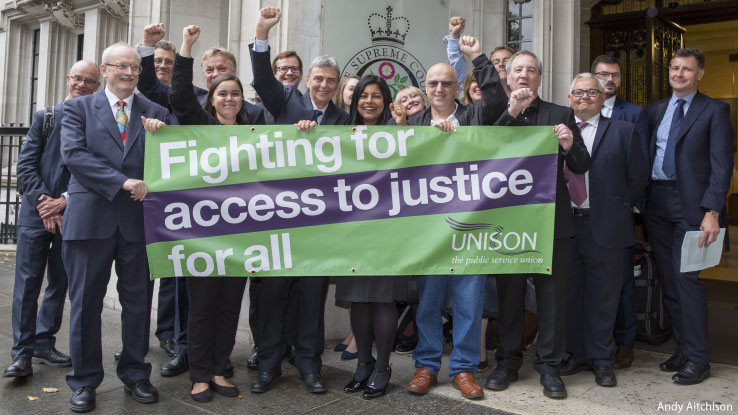
The trade union UNISON (the appellant), supported by the Equality and Human Rights Commission and the Independent Workers Union of Great Britain as interveners, challenged the legality of the Fees Order before the Supreme Court. They argued that the fees unjustifiably interfered with the right of access to justice under both the common law and European Union (EU) law, impeded statutory employment rights, and discriminated against women and other protected groups.
The government argued that the fees were lawful because there was no conclusive evidence that someone had been denied access to the courts due to inability to pay. It considered the fees affordable because poor people qualified for full fee cancellation and others had the disposable income to pay. Rejecting these arguments, the Court confirmed it does not require ‘conclusive evidence’ to determine denial of access to justice. It is sufficient if a real risk is demonstrated, and the Court inferred from the sharp, substantial, and sustained fall in the number of claims that a significant number of people who would otherwise have brought claims found the fees to be unaffordable. The discretionary fee cancellation was deemed inadequate as the problems identified were systemic rather than confined to exceptional circumstances. It further held that it is not only unaffordable fees that prevent access to justice, but also circumstances where fees would render it futile or irrational to bring a claim. Significantly, the Court found that the fees cannot be regarded as affordable “[w]here households on low to middle incomes can only afford fees by sacrificing the ordinary and reasonable expenditure required to maintain what would generally be regarded as an acceptable standard of living.”
The Court determined that even an interference with access to the courts which is not insurmountable will be unlawful unless it can be justified as reasonably necessary to meet a legitimate objective. There were three justifications given for the impositions of fees. First, that fees would shift some of the cost burden from taxpayers to those who used the system. Second, to disincentivize pursuing weak or vexatious claims. Third, to encourage earlier settlements. On the available evidence, the Court rejected each justification.
Amongst other legal references, the Court drew at the domestic level on the constitutional right to unimpeded access to the courts and at the regional level on the norm of effective judicial protection as enshrined in the European Convention on Human Rights and reaffirmed by the Charter of Fundamental Rights of the European Union. Ultimately, the Court found the Fees Order unlawful under both domestic and EU law for having the effect of preventing access to justice, and ordered it quashed.
The Court also found the Fees Order to be indirectly discriminatory under Section 19 of the Equality Act 2010 because the higher fees for certain (i.e. Type B) claims put women and others with protected characteristics, who bring a higher proportion of such claims, at a particular disadvantage.