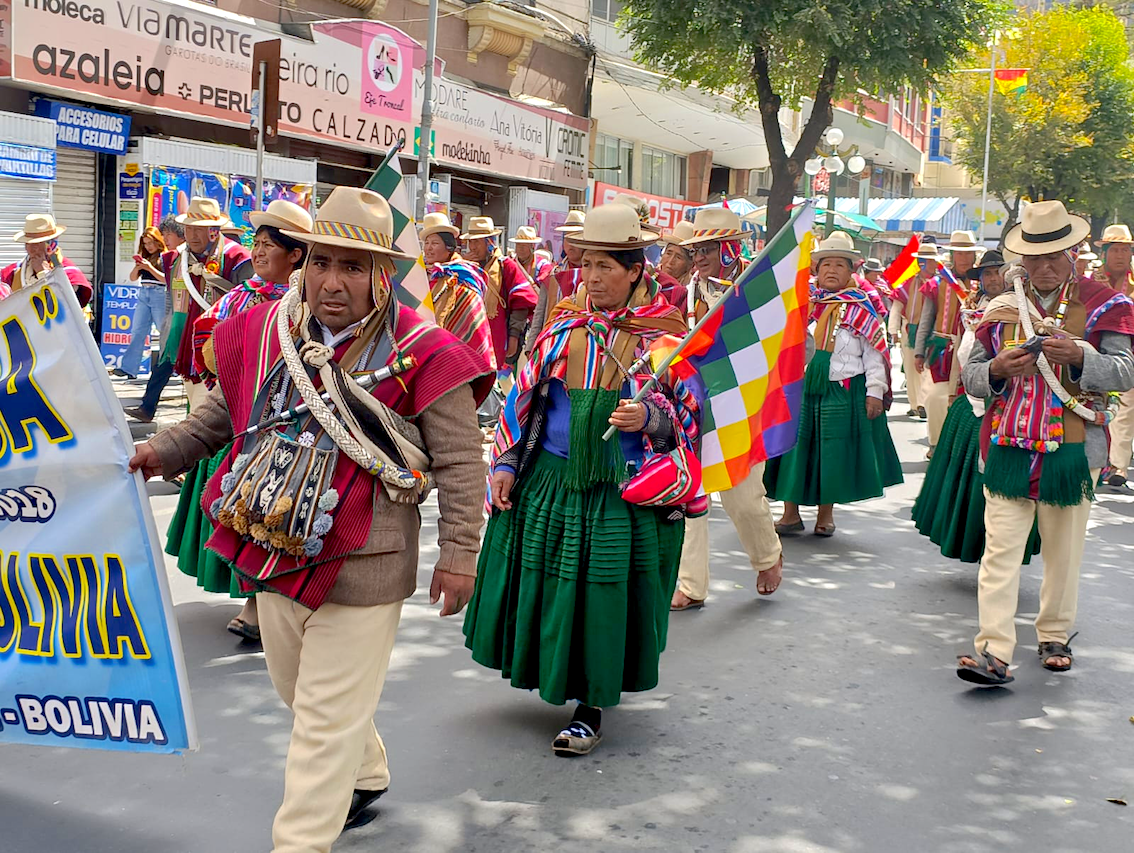
As members of the ESCR-Net Social Movement Working Group, we write to express our solidarity with the people’s movements from across the Plurinational State of Bolivia who have been leading a protracted social uprising in opposition to the neoliberal and repressive government of Rodrigo Paz.
We recognize that the economic crisis facing Bolivia is the result of neoliberal economic policies and agrarian reforms that prioritizes the interest of corporations and the extractive sector, over the rights of people.
We echo the concerns of our member, Red Chimpu Warmi, and of other Indigenous. Peasant and feminist movements who are bearing the brunt of the economic crisis and who have been unjustly scapegoated. These communities are facing stigmatization, discrimination, and organized abandonment while supplying the essential labor that guarantees the country’s food security:
We are the ones who contribute greatly to the country’s food security; we work in the fields, bring our produce to the cities, and, through hard work, provide food for many Bolivian families.” – Petrona Fernández Osco, Administrative Secretary, Red Chimpu Warmi
Across Latin America and the Global South, we are witnessing an aggressive reassertion of U.S. imperial power and oligarchic rule. From Argentina to Honduras, from El-Salvador to Ecuador, right-wing forces aligned with U.S. interests seek to weaken popular sovereignty, dismantle collective rights, and punish movements and territories that dare to imagine another future.
We amplify the demands being heard from across the Plurinational State of Bolivia – we support the call for an end to the repression, criminalization, and discrimination of Indigenous communities. We affirm the rights won by Indigenous communities, including ILO convention 169, which guarantees Free, Prior, and Informed Consent. We reject the dispossession and displacement that accompanies capitalist economic prescriptions at the expense of human rights. We further condemn the violence suffered by communities, families, women, girls, and the elderly. We urge the building of bridges of intercultural understanding to foster dialogue.
Throughout history the people of Bolivia have shown the world the power of collective action. They have inspired hope in many of us in their historic triumphs over attempts of privatization. The future of Bolivia is with its original peoples, with those who steward and care for the land and territories.